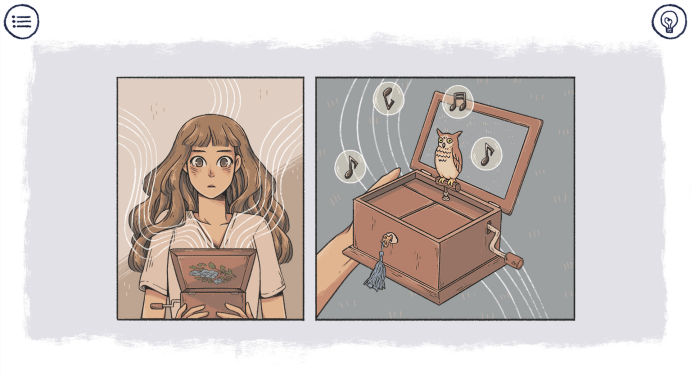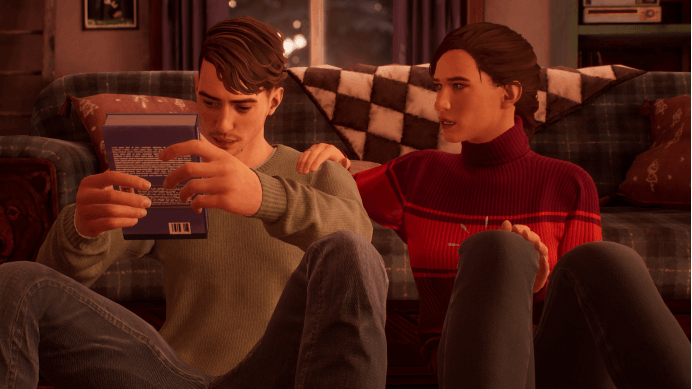
When I shared my memories with my twin sister Allison for the first time in the small town of _Tell Me Why_ in Alaska, two completely different childhood images were played on the screen at the same time — the same attic, in Taylor’s memory, it was a cage imprisoned by his mother, and in Alison’s memory, it was a fantasy fun. Field. At this moment, the game reveals the deepest dilemma of identity with its delicate brushstrokes: the truth we think is often just a one-sided truth after memory screening.
The game opens with a reunion after ten years of separation. The twins Taylor and Alison reunited due to their mother’s death, but found themselves sharing the supernatural ability of “telepathy”. But what really makes this setting go beyond the stereotype is the game’s deep understanding of the identity exploration of the LGBTQ+ group — when Taylor returns to his hometown as a transgender, the reaction of every town resident is like a social lens: some people stubbornly use the old name, some deliberately avoid gender, and some sincerely try to understand.
The most shocking narrative takes place in the chapter “Lighthouse Puzzle”. Twins need to recall the details of the day their mother’s death together, and the game will ask players to choose who they believe in. This seemingly simple choice will affect all subsequent conversations — choosing Taylor’s memory will strengthen his self-identification as a man, and choosing Alison’s memory will reveal her perception distorted by guilt. The most wonderful thing is that the correct answer often exists in the gray area of two versions, just like the memory in reality is never black or white.
The game’s portrayal of the “transition period” is touching. The clerk’s understanding smile when Taylor bought hormone drugs at the pharmacy, the subtle expression when he was called by a stranger with the correct pronouns for the first time, and the sentence “that’s me, but it’s not me now” when he faced his childhood photos — That tearful night became the warmest redemption in the game. Especially in the museum chapter, when Taylor found that his mother had already accepted his identity change and specially collected the male toys he liked when he was a child, the tearful night became the warmest redemption of the game.
As the truth surfaced, the telepathy mechanism showed a deep metaphor. Every memory synchronization reshapes the twins’ self-awareness: while Taylor accepts her transgender identity, she also needs to accept the past as a “sister”; while understanding her brother’s transformation, Alison also has to face her ignorance and hurt at that time. When the game finally revealed the truth of the mother’s death, the secret that had been hidden for many years became the beginning of healing — it turned out that the most needed reconciliation was always the relationship between himself and himself.
On the weekend after customs clearance, I contacted my cousin whom I hadn’t seen for many years. The most lasting gift of this game is that it makes me understand that each person’s identity is a mosaic that requires a lifetime of piecing together, and the real courage is not to be right in the eyes of others, but to face the truest self honestly. If you are also wandering on the road of finding self-identity, _Tell Me Why_ will give you the most gentle companionship — it will not give you a standard answer, but it will make you believe that being your true self is the most beautiful way of existence.